This will be a longer-than-normal post.
Please don’t tldr; as the information is necessary for future reference.
Now that you’re working with clean hands, the next step is to work with clean surfaces, utensils, pots, pans, and containers.
If you’re blessed with a dishwashing machine, most of the time you’re good-to-go for whatever passes through the entire cycle.
For items that can’t be run through the dish machine, as they are too large, too small, or are marked “Hand Wash ONLY” you will need a sanitizer.
Broadly, there are three food service sanitizers:
Iodine. Chlorine. Quaternary Ammonia.
• Iodine solutions stain surfaces and fabrics, and require rinsing.
• Chlorine can damage certain materials, particularly fabrics, and must be thoroughly rinsed from food contact surfaces. Many chlorine products (such as wipes) state clearly: NOT for food contact surfaces.
• Quaternary Ammonia (“Quat” in restaurant speak) products for food-contact will sanitize most surfaces in 60 seconds, and does not require rinsing. Check the label. Some say “allow to air-dry before use”.
The “no one has time for that” cheater way is to spray the “Quat” wait 2 minutes (2x instructed) and dry with a clean paper towel.
Then allow to air dry, prior to placing food in contact with the item sanitized.
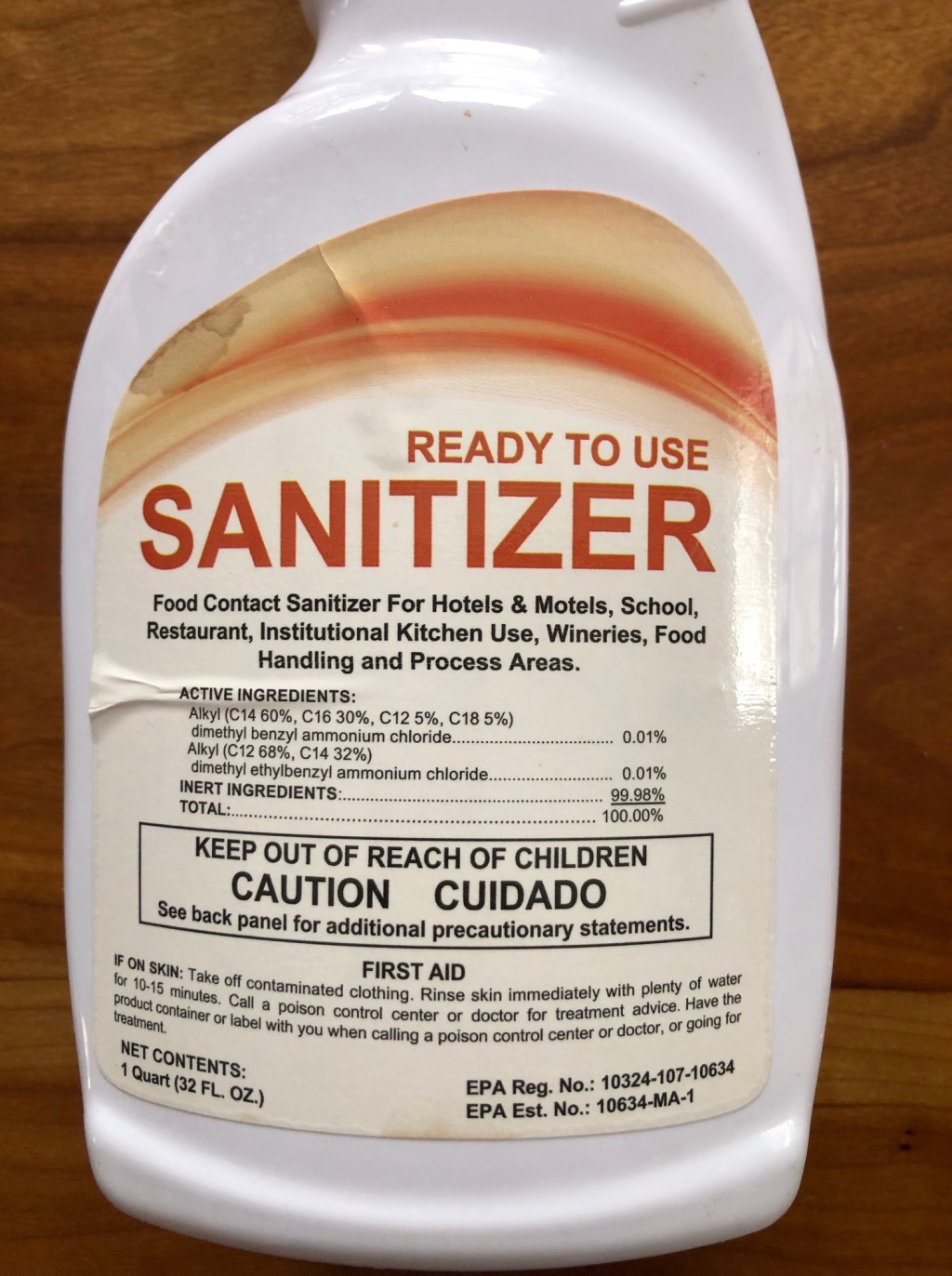
The accompanying photograph shows a Ready-to-Use product from Alpha Chemical in Stoughton, MA.
Sold through restaurant supply stores, the quart spray bottle retails for ~ $11 to 15 each.
A company in Iowa called Great Western offers a similarly labeled product “Spartan Sani-Tyze®” sold by the 12 bottle case for ~$57 plus $18.75 for shipping.
Alternatively, Amazon offers Purell Foodservice Surface Sanitizer Spray by the 6-pack case for only $29.50.
*prices shown on the respective websites, 26 March 2024.
Now that you have cleaned and sanitized workspace… a few general rules:
There is NO “5-second rule” – no exceptions.
If it hits the floor? You have three options:
• It is trash. Throw it out.
If you would not lick the floor?
Don’t put that in anyone’s mouth.
• It needs to be washed and sanitized.
That includes your toddler’s binky. Binkies. Fleet of binkies.
• It needs to be washed and peeled before use. “I’m peeling that so why wash it?”
Dirt.
The dirt that contacts your peeler’s blade, and now is on your food.
Workflow – the Basics
We will address this repeatedly, particularly in how recipes are worded.
Today, however, lets begin with the basics.
Preparation of your meal ingredients.
In the restaurant trade, this is called “Mise en Place” or putting everything in place prior to cooking.
Wash your hands.
Sanitize your surfaces and equipment.
Gather your ingredients – do NOT put your boxes or packages on your sanitized work surface (cutting board).
Wash your hands.
Wash your produce, unless the package specifically states: “ready to eat – triple washed”
which is common to some salad greens, such as Spinach.
Prepare your veggies. Peel, chop, dice, shred.
Clean and sanitize your cutting board and utensils. While you’re at it, wash your hands.
This is a good opportunity to use disposable vinyl or nitrile gloves.
On Amazon, Vinyl gloves average $8 per 100. Nitrile average $11 per 100. For the extra $3, get the Nitrile.
They’re easier to use, don’t rip as easily, and are less “baggy” on your fingers.
Open your proteins (meats, eggs, cheese).
Prepare your protein ingredients in order of potential bacterial contamination. Least to most.
Cheese. Slice, shred, cube.
Fish.
Clean and sanitized your cutting board and utensils.
Cuts of Beef.
Cuts of Pork.
Other four-legged critters.
Ground meat.
Clean and sanitized your cutting board and utensils.
Eggs.
Poultry, including game birds.
Clean and sanitized your cutting board and utensils.
That seems excessive doesn’t it?
In reality, how many nights are you preparing salad, veggies, cheese, fish, beef, pork, lamb, goat, venison, hamburger, eggs, chicken, turkey, ostrich and quail?
Right. You’re not.
On your clean and sanitized workspace:
Prepare your salad ingredients.
Prepare your veggies.
Prepare your protein.
Clean up and sanitize your workspace.
Then cook and plate.
Your goal, is to ensure there is a 0% chance of raw food, that may be contaminated with bacteria,
ever comes in contact with the cooked food.
Notes:
A selection of appropriate sized bowls are simply awesome when maintaining a clean and organized workspace. This set of 6 from Amazon, are durable and are priced at $9. That’s $1.50 each.
Dollar General might not do as well for similar sized plasticware.
An important safety tip:
Avoid clear glass for your food preparation materials.
If shattered, you may not find all the pieces in your ingredients.
You’re better off avoiding glass altogether.
Stainless, enameled metal, plastic, wood, bamboo… there are plenty of other options.
~ G




 The Poverty Kitchen
Leave a comment