Understanding knife construction.
Kitchen knives are largely segregated into two broad groups:
Steel knives – the vast majority of knives sold, and…
Ceramic knives – which haven’t quite taken the world by storm.
I’m going to ignore ceramic knives, not out of prejudice,
but rather a desire to concentrate on the items you’re most likely to find at retail.
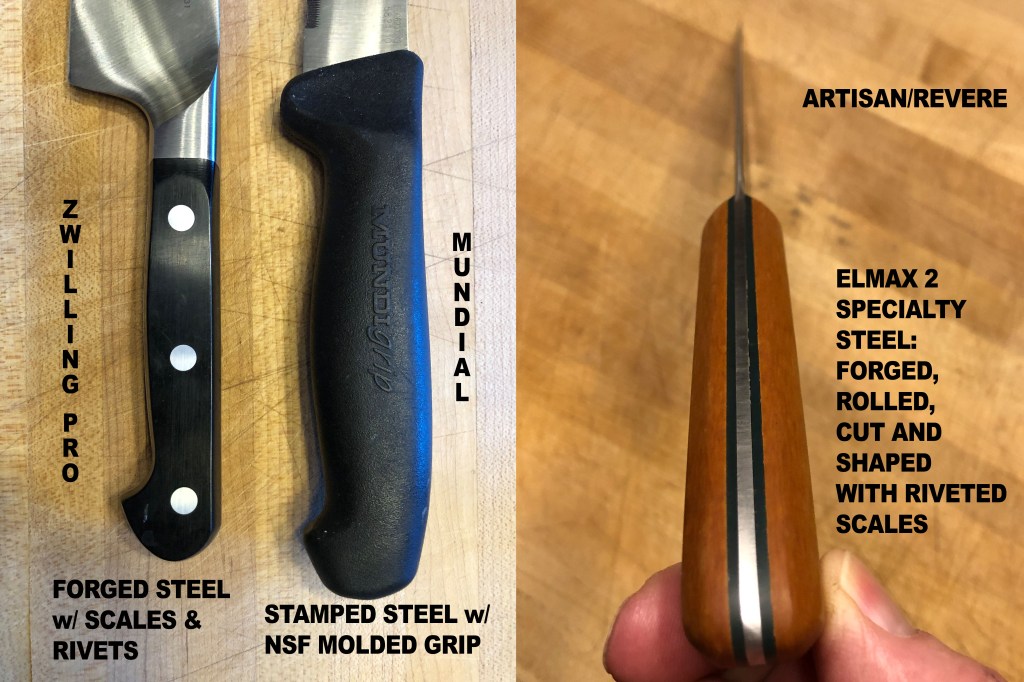
In the accompanying photo, there are two basic handle types on three knives:
Traditional style wood or synthetic resin “scales” that are attached to the knife by rivets,
and injection-molded thermoplastic “over-molded” grips made to an international standard called “NSF” here in the USA.
Also shown are three different methods of knife blade construction:
The Zwilling® Pro uses a traditional full-tang forged construction.
The Mundial® uses a modern stamped steel construction with a partial tang hidden within the thermoplastic grip.
The Artisan/Revere® shown to the right uses a proprietary process of creating the steel, an earlier use of forging equipment, and finally a foundry roller process to create the desired thickness.
Each blade undergoes further shaping and sharpening before being sold to the consumer.
Which one is “best”?
Well… let’s talk price, based on a common 8-inch Chef Knife:
The Mundial® and similar knives from Forschner/Victorinox® or Dexter/Russell will range from $18 to $65 USD via popular online retailers.
Why the range?
The quality of the stainless steel, and occasionally the grip will be of better quality and ergonomics.
A low-price point knife to capture the fast food/sandwich shop market, and a higher quality steel NSF-compliant knife for restaurants and meat processors.
ANY of these would be a vast improvement on the paring and steak knife shown in Part 2 (A).
The trio from Germany: Henckels/Zwilling®, Wusthoff®, F Dick®, and the French standard Sabatier® are your traditional European knives.
Each of those companies offers entry-level products which may include products made in other countries, often to a lower standard.
Read carefully before purchasing.
Each of the German companies offers riveted scale “Gourmet” or “Superior” lower-priced models for the home cook market. Online retailers have the 8-inch knife in this series for around $75 USD.
They also offer over-molded thermoplastic grip models that are marketed as rivals to other NSF® commercial use knives. The quality is uniformly good, possibly a little better steel than the lower-priced NSF® knives mentioned above, though the steel used by Victorinox® is really very good.
Sabatier® appears to only offer their traditional series of knives – although – not all knives marked “Sabatier” are made in France.
The four mentioned European makers offer more than one deluxe line.
The traditional forged knife with riveted black or natural hardwood handle is their homage to the past. If it works, well… more on that in the next paragraph.
The MSRP for the 8-inch Chef’s knife averages $150-165 USD. The 7-inch is $15 less, the 9 or 10-inch is roughly $200 USD.
You can find them for significantly less by shopping around.
eBay might be an option if other online retailer prices are out of reach.
We’ve done really well on eBay, but we know what we’re looking for and avoid anything without a “returns accepted” seller policy.
Each German maker has a modern line of “improved” designs often for more money.
We can’t say they are never seen in a commercial setting… but you’re more likely to see knives by Global® or one of the well-known Asian makers like Shun®.
A word of caution:
Japanese knives by reputable makers are excellent slicing tools.
They also chip and break more easily if misused for chopping through bone or hacking through a tough squash rind.
Any kind of torque (twist) and you will snap or chip that slender blade.
We have some Japanese knives and use them when precise slices are needed, or when there are a lot of thin slices to produce, as it’s more effortless than a Western Pattern knife.
Buy one when you have the extra cash, and the discipline to put it aside and reach for a stout knife when needed.
Custom and Semi-custom knives:
The 8.25-inch Artisan/Revere® shown to the right, has a current (early 2024) price of $445 – and they’re sold out.
We were lucky and bought it via Kickstarter for far less money.
The A/R is a very sharp, very easy-to-use knife.
It’s also on the bottom end of Semi-custom and Custom handmade knife prices.
If $445 makes you gag, don’t go looking for a knife made by Murray Carter.
You could buy the A/R Executive package (that’s one knife in three sizes + a bespoke cutting board) for ~ $700 less than Murray Carter’s lowest price Chef knife.
Your favorite Poverty Kitchen Blogger would be willing to test Murry Carter’s 8.54″ Master Smith #539 International Pro Gyuto.
Of course, a full review would be posted… after the drooling was adequately controlled.
~ G
La Cucina Povera – a term from Italy for the peasant’s kitchen. The kitchen of the poor. The Poverty Kitchen.
Welcome to The Poverty Kitchen,
La Cucina Povera – a term from Italy for the peasant’s kitchen.
The kitchen of the poor.
The Poverty Kitchen.
The concept of the poverty kitchen can be found globally and is really about making great food with simple high quality, and seasonally available ingredients.
Let’s connect
Keep in Touch
Stay updated with our latest, by joining our newsletter.




 The Poverty Kitchen
Leave a comment