In this segment, we will explore kitchen knives in the broadest of terms.
There are thousands of knives and knife styles from around the world.
The typical American kitchen will use a “French” or “western pattern” knife.
We use them extensively too, but not exclusively.
For some tasks, an “eastern pattern” or “Asian” knife is easier to use.
Sushi for example, has Sushi knives. Often, one per type of Sushi.
That’s waaay further into the weeds than necessary for 99% of cooks.
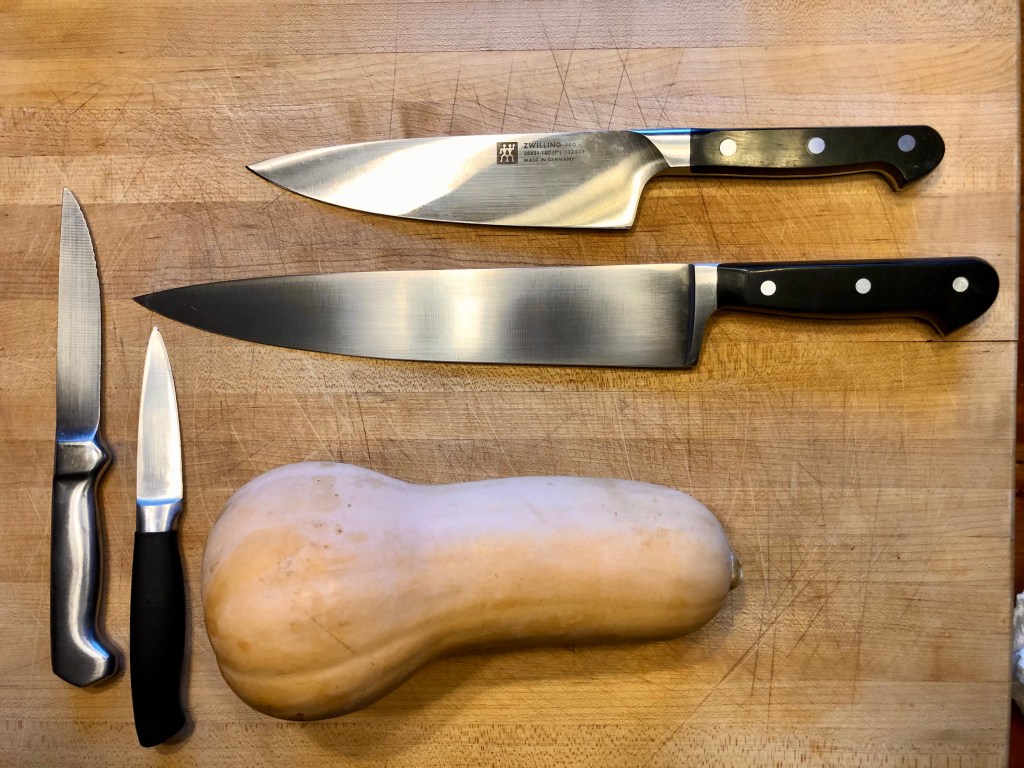
In the associated photograph you will see a 7-inch Henckels Zwilling® Pro knife, and a 10-inch Wusthoff® Trident Classic knife.
Either would be ideal for cutting the butternut squash shown in the photo.
Or for mincing parsley, or for separating chicken legs and thighs, or for slicing onions, or for…
They are typically general-purpose knives,
making that style very popular in commercial kitchens.
To the left, you will see an anonymous brand stainless “steak knife” and an Oxo® GoodGrips paring knife.
Sadly, both are too common as ‘the knife’ in many kitchens.
Something I’ve learned from experience.
“Hey, can you come over and help cook? I have everything we need.”
(Except for adequate tools.)
Why do people insist on buying and using these inadequate knives?
“I like small. Those other knives scare me.”
Once you learn how* to use them, they are not in the least scary.
“They’re cheap. I don’t really see a reason to spend money on a knife.”
Knives are an investment.
The 10-inch Wusthoff® pictured was purchased 35 years ago for $85 USD.
That is an annual cost of under $2.50/year.
The paring and steak knife are more dangerous than a chef knife as they are too small, likely too dull, and have minimal control surfaces.
*We will explore knife techniques in a later post on kitchen skills…
and YouTube is your friend.
In our next post, we’ll explore knife construction.





 The Poverty Kitchen
Leave a comment